
“The Things We Can See and Touch Awaken the Imagination…”
Lewis Mumford’s Century-Old Advocacy for Local History Rings Truer Than Ever
By Bill Jeffway
A version of this article appears in the September 9, 2026 issue of the Northern/Southern Dutchess News / Beacon Free Press.
Addressing the topic, “The Value of Local History,” Lewis Mumford spoke to members of the Dutchess County Historical Society who gathered at Troutbeck in Amenia one hundred years ago, on September 15, 1926. They came to hear this thirty-year-old young man, already an emerging national writer, address what might seem a simple question to an audience that needed no convincing. But putting an answer into words is harder than it looks, and a century later we benefit from his having done so. We also see how Mumford’s advocacy of local history fit with larger philosophical discussions about history at the time, including George Santayana, the source of the famous quote in 1905, “those who cannot remember the past are condemned to repeat it.”
The recent discovery of one of Mumford’s books signed by Santayana in December of 1926 as he gave it to a friend, is an example of Mumford’s argument that the things that we can see and touch have a unique power to ignite the imagination.
In 1926, Mumford published what became one of his most significant books, The Golden Day. In it, he was amplifying Santayana’s thinking that an active engagement in learning about our past was the only way to have human progress. In The Golden Day, Mumford confirmed his alignment with Santayana saying about history, “When we are integrated [with our past] we grow like the tree; the solid trunk of the past and the cambium layer where life and growth take place.”
Mumford would go on to become one of the most influential American writers on cities, architecture, technology, and the relationship between people and the places they create. But on that September afternoon in Dutchess County, he turned his attention close to home.
Mumford and his wife were at the Amenia estate of Joel and Amy Spingarn, the progressive reformers who would became the Mumfords’ own neighbors once the couple bought a house nearby. Troutbeck was no ordinary country retreat: it was the site of the Amenia Conferences of 1916 and 1933, pivotal gatherings at which the NAACP’s early leadership shaped the strategy of the emerging civil rights movement (See Julia Hotton, DCHS 2017 Yearbook). Mumford’s message to the historical society that day is no less relevant now.
“The things that we can see and touch are those that awaken our imagination,” Mumford told his audience, contrasting them with “scenes and incidents one has taken solely out of books and secondhand accounts.” That distinction may be the simplest explanation of why local history matters. History can easily become abstract. We memorize dates, wars, presidents, legislation, great national movements.
Then, suddenly, the distance between past and present begins to collapse. The person was here. The road was traveled. The words were written by an actual hand. You feel a connection not possible in any other way.
That was not an argument against books or scholarship — Mumford was himself a formidable scholar. But he argued that the physical evidence around us gives history an immediacy that books alone cannot. He saw this clearly at Troutbeck, where the surrounding landscape of Amenia offered evidence of successive generations: family names, houses, roads, architectural styles, traditions, and stories. A historian, he suggested, could use fragments like these much as a naturalist uses a handful of bones to reconstruct a much larger creature.
That leads to his second important idea: local history is not “less” than national history. Quite the opposite.
Mumford argued that when we examine a particular community carefully, its history inevitably leads outward. War, slavery, emancipation, industrialization, and changing ideas about government all eventually leave their traces somewhere. National history happens locally.
In 1926 Lewis Mumford helped DCHS members answer the question, “What is the value of local history?” while engaging with other philosopher historians on the topic.
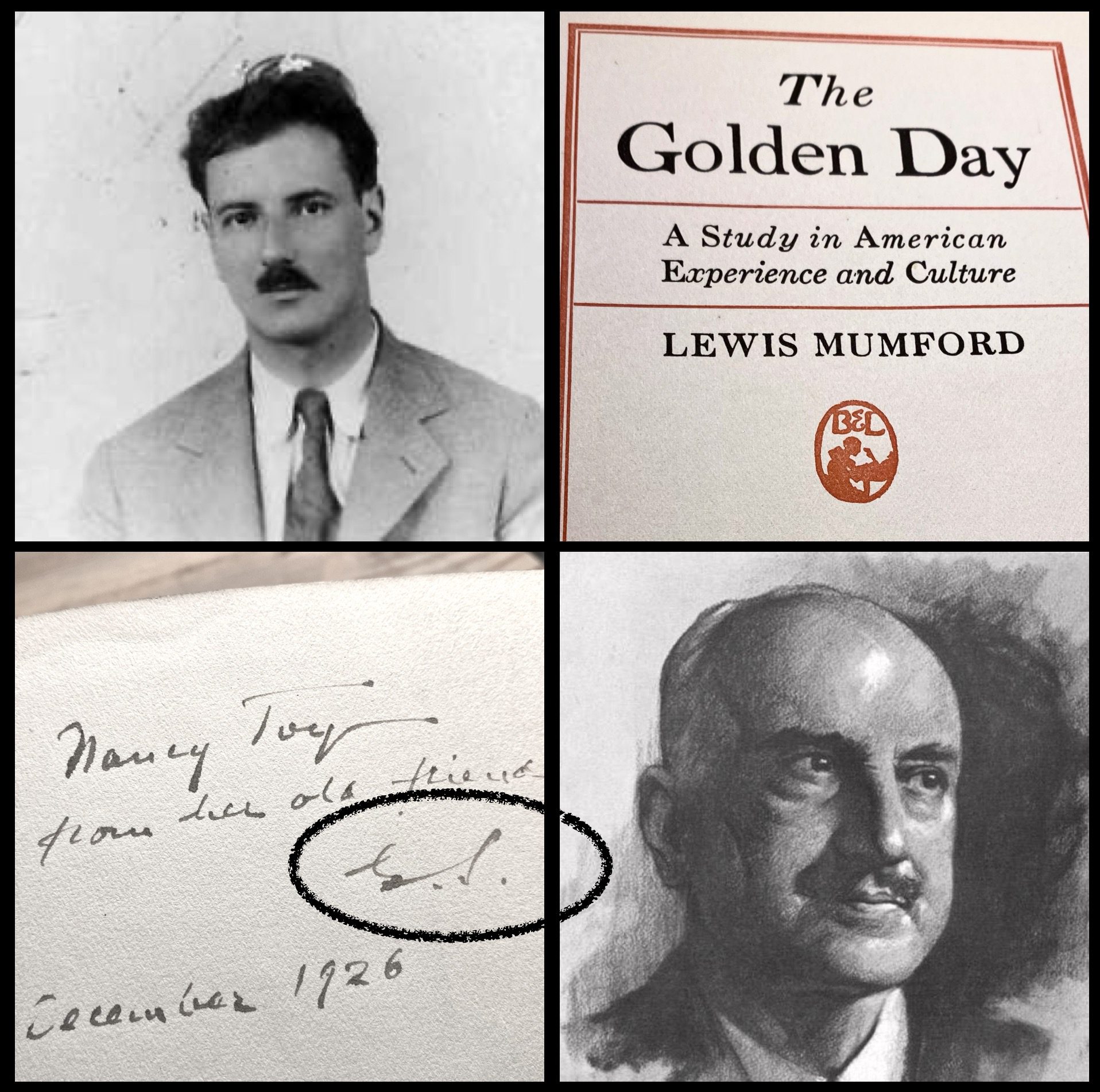
Above top left to right: Photo of Lewis Mumford around the time of his September 1926 Troutbeck address to DCHS members and the title page of his book The Golden Day published the same year. In his book Mumford expressly refers to the historian George Santayana who famously wrote in 1905, “those who cannot remember the past are condemned to repeat it.” Above lower left to right: In December 1926 Santayana inscribed a copy of Mumford’s book and gave it to a friend [DCHS Collections]. Also, in December 1926 Santayana wrote to Mumford making several critical points about Mumford’s Golden Day.[Archives at Indiana University, Indianapolis].
A law may be passed in Albany or Washington, but its consequences arrive at somebody’s doorstep. A war discussed in histories of presidents and generals eventually means a particular young man leaves a particular farm.
Mumford described great events as waves moving across the country and leaving something behind in individual communities. That metaphor remains useful today. The American Revolution left its deposit here. So did slavery and abolition, immigration, and the shift from an agricultural to an industrial economy. The struggle for women’s rights, the arrival of the railroad and the automobile, two world wars, and the civil rights movement can all be found in Dutchess County, if we take the time to look.
Local history, then, does something more important than provide colorful anecdotes to decorate the national story. It changes our understanding of that story.
There is another part of Mumford’s argument that feels especially apt on its hundredth anniversary. He treated remembering the past and imagining the future as inseparable acts, not opposite ones. A community with a sense of its own past has a sense of continuity. It understands that people came before, made choices, succeeded, failed, built things, destroyed things, solved problems and created new ones, and that we are doing precisely the same thing for the generations that will follow. We are not standing outside history. We are somewhere in the middle of it.
That idea may have even greater relevance in 2026 than it did in 1926. We live increasingly in a world that is instantaneous, digital, and geographically unmoored such that we had to create a new word: the “deep fake.” Artificial intelligence can search, reconstruct, and interpret enormous bodies of material, and millions of historical documents can be consulted without leaving home. Those are remarkable opportunities. But they also make Mumford’s distinction more important, not less. A digital image of an eighteenth-century document is useful; it is still different from standing before the document itself. A photograph of an old house conveys information. Walking through its doorway conveys something else. Reading that an event happened at a particular place gives us knowledge. Standing there can awaken imagination — and imagination is essential to historical understanding, because history gets understood through the eyes and ears we have developed from our own unique, personal experience. This is how different people can take different lessons looking at the “same” history.
Perhaps that is part of why Mumford’s address has endured. The Dutchess County Historical Society published “The Value of Local History” in its 1927 Yearbook, and it has been reprinted and cited ever since. Its message was never simply that communities should celebrate themselves or collect charming stories about earlier days — Mumford explicitly warned against that kind of narrow local pride. The deeper purpose of local history was self-knowledge.
The Golden Day made much the same argument about the country as a whole and it found real readers among the very people it examined. A first edition of Mumford’s book survives, inscribed by “G.S.” (Santayana himself), to Nancy Toy, a friend from his Harvard years, and dated December 1926 — the same month Santayana wrote to Mumford directly to discuss the book. The item offers a small, tangible thread connecting the philosopher who diagnosed America’s divided culture and need to embrace history, the book that answered him, and the valley where Mumford first tried the argument out on his neighbors.
By understanding one place deeply, we begin to understand larger places. By understanding people who lived before us, we become better equipped to understand people whose experiences differ from our own. And by recognizing that the landscape around us is filled with evidence of earlier lives, the seemingly remote past becomes personal.
A century after that gathering at Troutbeck, Mumford’s most enduring lesson may also be his simplest: history is not somewhere else. It happened here and it is vitally important if we want to improve generation to generation. The local things we can still see and touch can help us imagine it.
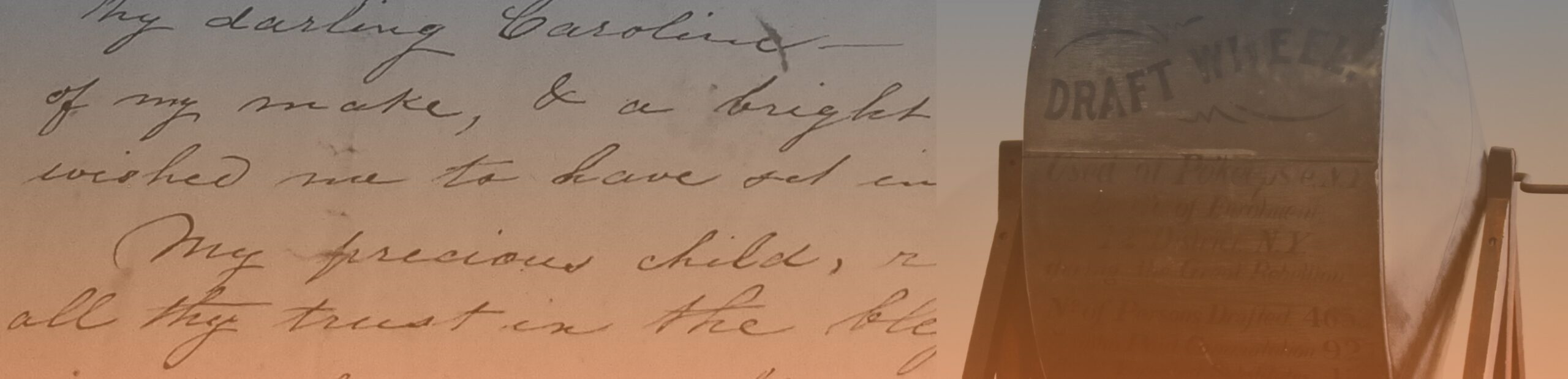
Powerful examples of things we can see and touch that awaken the imagination from DCHS Collections.
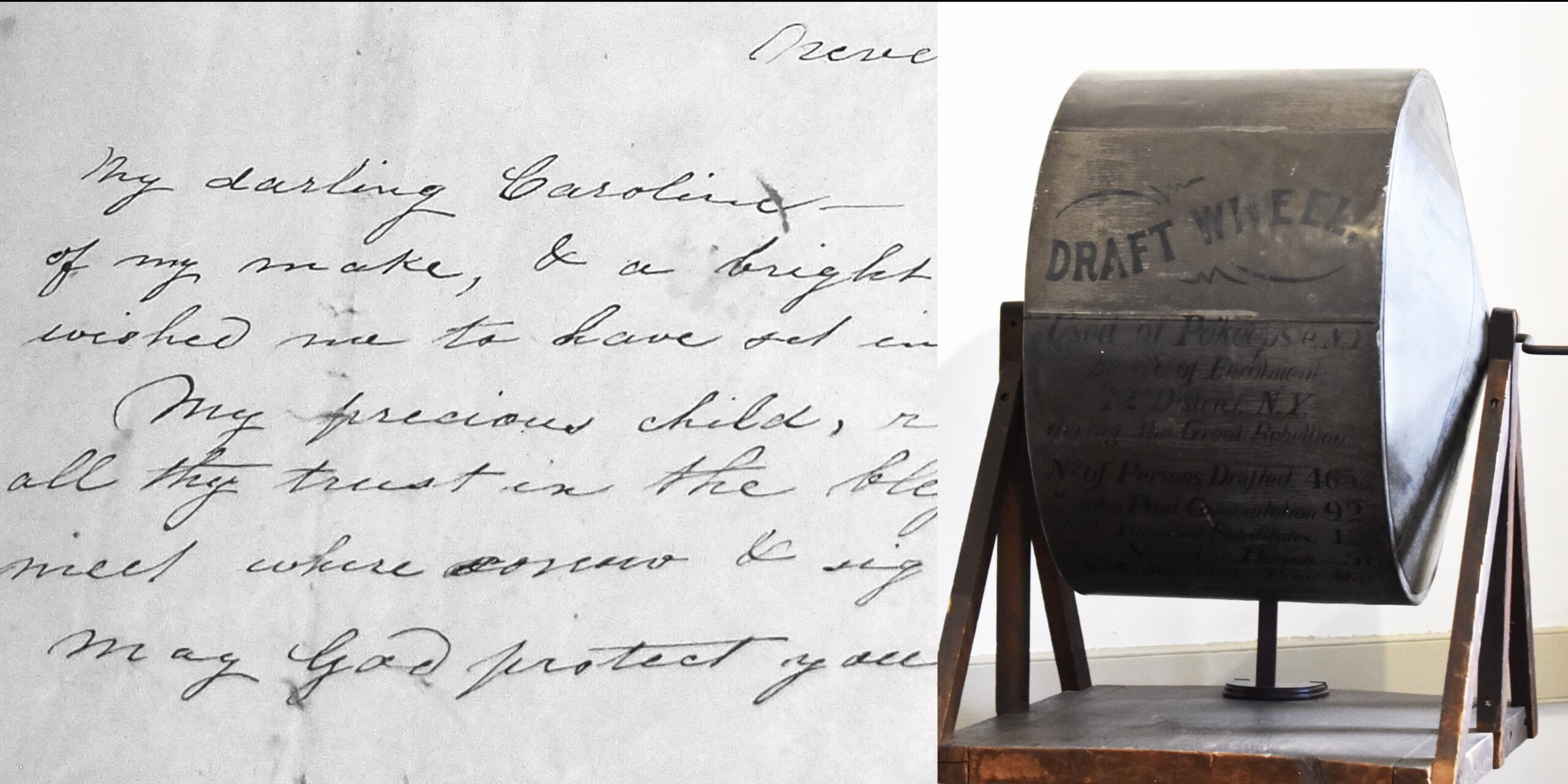
Above left to right: Among the powerful things we can “see and touch” in DCHS Collections is the December 21, 1840 letter to two-year old Caroline Clowes (who would go on to be the famous painter) from her mother who died three days later on Christmas Day. In the letter, Elizabeth Clowes tells her daughter to “trust in the Lord.” The draft wheel used in Poughkeepsie in 1863 during the Civil War when the volunteer effort was no longer adequate to carry on what became America’s deadliest war. Names on cards were pulled from a small door in the back.