
African Heritage
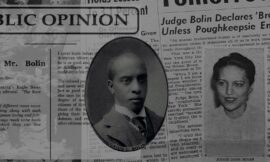
Gaius and Jane Bolin on Race
Father & Daughter: Views on Racial Justice Across Two Generations The Bolin Family Born in the nearby Quaker stronghold of the Town of Dover in 1826, Abram Bolin moved to this house on North Clinton Street in Poughkeepsie with his wife, Alice Ann Lawrence Bolin, before 1860. See their photos below. Among the children raised at the house was Gaius Bolin. Born in 1864, Gaius became the first Black man to graduate from Williams College (Class of 1889). He returned to this home until he set up his practice, and married in 1899. The home of Abram and Ann Bolin stands today on North Clinton Street. It is the birthplace of Gaius Bolin. Gaius Bolin (shown below) married Matilda Emery in 1899. A native of Enniskillen, Northern Ireland, Matilda came to Poughkeepsie as a child. At the home shown below, they had four children: Ann May, Gaius, Jr., Ivy Rosalind, and Jane. Matilda died in 1917, several months before realizing their plans to move to a larger house they were building on Grand Avenue. The home of Gaius and Matilda Bolin. Birthplace of Jane Bolin, the first Black judge in the United States.
Posted in: African Heritage
Judge Jane Bolin Speech at Brotherhood Dinner, Poughkeepsie 1944
Posted in: African Heritage
The Recovery of a Rural African American Burial Ground is a Recovery of Voices & Lives
Posted in: African Heritage, For everyone, Towns
Hyde Park’s New Guinea Community
Town Hall Workshop March 9, 2026 “I have worked at archaeological sites throughout the State. This is a remarkable resource. There is almost nothing like this in New York. The data is overwhelming, it is remarkable.” Matthew Kirk, M.A., RPA, Principal Investigator / Vice President, Hartgen Archaeological Associates.
Posted in: African Heritage
Sadie Peterson Delaney
Our online story about the extraordinary Sadie Peterson Delaney caught the attention of a big fan in England: Natty Mark Samuels, head of the African School in England. He was prompted to write a ballad dedicated to her, which is here performed by Poughkeepsie’s Angela Henry. The profile of Mrs. Delaney is below as well. The Ballad of Sadie Delaney By Natty Mark Samuels, head of the African School in England. Read by (Grace) Angela Henry (13 minutes). Full program. Poughkeepsie’s Sadie Delaney: Healing the Trauma of War Through Reading This is an extract from an article published in the Northern/Southern Dutchess News on February 12, 2020, under the heading, African American Women’s Voices & Talents of a Century Ago by Bill Jeffway. Sadie (Johnson) Peterson Delaney (1889 to 1958) was both ambitious and successful in expanding a field of health and healing driven by books, called Bibliotherapy. We know from The Quill, the Parish newsletter of the the Smith Metropolitan AME Zion Church, that she was a prolific poet, and involved in many Church groups. From the October 21, 1915 issue: Mrs Peterson is one of Zion’s staunch supporters. She possesses considerable literary ability, is a willing worker, a splendid young woman and of a congenial personality. She is a born poet. Her productions are practically all spontaneous efforts and yet she has but few equals in the amateur poetic world. Each of her poems grip with a peculiar fascination, being clothed in beautiful language, the pathos so tender and the whole so original, varied and novel that one is carried along as in a delightful dream of admiration. Mrs. Peterson is serving our church as President of the J. W. Hood Literary Society, President of the General Claims Auxiliary No. 2, Leader of the Children’s Class, Sabbath School Teacher, and member of the Busy Bee Sewing Circle. She is one of the daughters of Zion of whom we are proud. New York State was having a referendum in the year 1915 on the question of women’s suffrage, of course only among male voters who were the only ones who could vote at the time. The question the ballot was whether the NY State constitution should be amended to allow women to vote. In an effort to drum up support among African-Americans the Equal Suffrage League of Poughkeepsie, led by Laura Wiley of Vassar College, held a meeting at the Smith AME Zion Church, the African-American Church on Smith Street in Poughkeepsie in 1914, a year before the referendum. Among the women of that Church who stepped up and spoke in support of women’s suffrage was Sadie Johnson Peterson. Interested in writing at the time, she read an original poem called, “A Suffrage Call.” Unfortunately we do not know exactly what she said. Peterson had moved to Poughkeepsie as a child in 1899 when her father took the job of Sexton at St Paul’s Episcopal Church. Sadie Peterson, 1915, Poughkeepsie. Dr. Delaney. She attended Poughkeepsie High School, and Miss McGovern’s School of Social Work, abley pivoting out of a difficult first marriage to focus on studying to become a librarian. She was 30 years old when she left Poughkeepsie to study at the 135th Street Branch of the New York City library system, now New York Public Library’s Schomburg Center for Research in Black Culture in Harlem. She was active there when the intellectual, musical and artistic activities of the Harlem Renaissance took place. Today, that library branch houses a collection of her letters, clippings and photographs. In 1924, the remarried Sadie Peterson Delaney took a position as librarian at Tuskegee Veterans Administration hospital. There she developed and evolved the practice of Bibliotherapy, working with doctors to use books to heal both mental and physical wounds. Imagine, a time before television, before the pervasive TV screen appeared in our hospital rooms to distract us, Bibliotherapy was a deeply thoughtful concept that looked at a very holistic approach to healing. Eleanor Roosevelt in her column “My Day” wrote in January 1957 applauding Mrs. Delaney and her practice of bibliotherapy. Roosevelt explained that Mrs. Delaney served 1,000 patients. She had added a library binding service to give patients vocational experience. She started a department for the blind, and classes in braille. At the Family Partnership building on North Hamilton Street you will find Poughkeepsie Public Library’s Sadie Peterson Delaney African Roots Library.
Posted in: African Heritage, Poughkeepsie
Douglass in Poughkeepsie 1858
“Emancipation Day.” This was the name of the holiday recognizing the date of August 1, 1834, as the date that the British Slavery Emancipation Act began the graduated process of freeing slaves in the British Empire. The greatest impact was in the Caribbean, or British West Indies, where the holiday is still celebrated in some parts. New York State had abolished slavery a few years earlier, in 1827. But it was not until the Emancipation Proclamation was issued by President Lincoln, on January 1, 1863, that the graduated process of freeing millions enslaved in the US began. Consequently, there was a mix of celebration of what was achieved, and profound determination to “finish the job” in the United States. One of the largest gatherings for the holiday, was the Emancipation Day taking place on Monday, August 2, 1858 at Poughkeepsie’s College Hill. The main highlight was the nationally renowned thought leader, abolitionist, author, publisher and speaker, Frederick Douglass. People came from across the whole Hudson Valley. A formal procession from the AME Zion Church (then on Catharine Street) went to the dock to greet arriving guests at the Hudson River, and formed a group procession across Main, Catharine, Mill, Hamilton, Mansion, and Clinton Streets. Their destination was “College Grove,” on the west of College Hill at Clinton Street, where a platform had been raised for the speakers. Along with chairs, tables and non-alcoholic refreshment. Frederick Douglass gave a two-hour speech to a crowd of approximately 4,000 individuals. Although we do not have reports of exactly what Douglass said, we can get some idea by looking at earlier talks he gave. This was not Douglass’ first time in Poughkeepsie. Just six months earlier, in January, he spent several days giving a series of lectures. We get some very specific insight to Douglass’ thoughts through the diaries of Edmund Platt in the DCHS Collections. He would have been just 15 years old at the time when he sat in the audience and listened to Douglass on January of 1858 at the Universalist Church. Platt would go on to found what would become the retail giant Luckey, Platt & Co., which operated on Main St. until 1981. He authored a landmark history of Poughkeepsie in 1905. He was also involved in the business of his brother and father, who were publishers of the local newspaper, the Poughkeepsie Eagle. From the Platt diaries: Tuesday, January 12, 1858. “In the evening I went to hear a lecture by Frederick Douglass, it was very good. He used to be a slave. He told how he learned to read and write and [do math]. In the first place he was given to a boy named Tomas Hall who was kind to him ,and when Tom’s mother [taught Tom] his letters, she forgot to put Fred out of the room. Until by and by, he knew all the letters , he learned to spell and read a little. He then went into the shipyard, and when the carpenters wrote on the timbers, he asked what that meant and they told him. And pretty soon he could write the letters in those words himself. Then on the street corners, he told the white boys he could write. He made a few letters. And as they wanted to show their skill, they wrote down the whole alphabet so he had a copy. He learned by picking up a little at a time. And at last he ran away and has not been back since.” Thursday, January 14, 1858. “In the evening I went to hear Mr. Douglas again. His subject was the effects of slavery. First, he said the same winter the pilgrims landed at Plymouth Rock another Landing was made in Virginia. It was a shipload of slaves.” “He said they had gone on until they had stopped freedom of speech in the southern states. They tried to stop freedom of speech in the Senate when Brooks cained Sumner [On May 22, 1856, after anti-slavery Massachusetts Senator Charles Sumner made a stinging verbal attack on pro-slavery Stephen Douglas and Andrew Butler, South Carolina’s congressional representative entered the Senate chamber and beat Sumner with a stick until he was unconscious and bleeding and had to be carried out]. And they want to stop free speech in the northern states and to establish the slave trade.” “He said they had gone so far now as to make a lot against the law of God that in the fugitive slave law that says, ‘You must not feed the hungry, clothe the naked.’ He said when he was running away he would rather come in contact with a nest of rattlesnakes than a Democratic prayer meeting.” “He preached a short sermon on the text ‘servants obey your masters.’ He said he had heard preaching on this subject till his head ached. I forgot the first of the sermon, but some of it was the white men have braved the perils of the ocean and snatched the Negroes from Africa like brands from the burning. The Negro should obey the white because they had soft skin, white hands, etc. I cannot remember all the lecture and cannot put down here all I remembered.” Platt did not attend the Wednesday, January 13 lecture. Newspapers reported that Douglass was speaking that night on the topic of “respecting the different races of man, showing that they had originally a common origin, that under like circumstances, and with the proper opportunities, the Africans had shown themselves equal to others as was proved by the history and character of the ancient Egyptians the Carthaginians, etc. In this he displayed great research and much skill in answering the argument against his position strengthening his own doctrines by facts and illustrations.” Of course, a shift in emphasis happened after the Civil War. By 1868, an “Emancipation Celebration” took place on September 16. The route, from the AME Zion Church then at Catharine Street, to the river, and back was similar to the
Posted in: African Heritage