
For everyone
Yearbook Submissions
The Dutchess County Historical SocietyDCHS Yearbook Submission Guidelines (August 2026) DCHS 2026 Yearbook Deadlines Window: September 1 to October 31Each author should negotiate their own specific deadline within that window The Dutchess County Historical Society Yearbook (ISSN 0739-8565) is unique in that no other organization in New York State has continuously published a historical journal for so long. Since 1914, the DCHS Yearbook has served as the most respected and accessible historical journal investigating and celebrating Dutchess County’s past. While scholarly (and footnoted) it is meant to be of more general interest than a peer-reviewed academic journal. The Dutchess County Historical Society Publications Committee actively solicits articles, essays, reports from the field, and case studies that support its mission to collect, preserve, interpret and share the history of Dutchess County as a way to inform and educate present and future generations. DCHS seeks to promote and interpret local history through the publication of original research and case studies that address personalities, places, businesses, and events in and from Dutchess County, New York, as well as the county’s relationship to national and international events. The DCHS Yearbook, along with exhibitions, programs, and shorter articles, plays an important and foundational role in the act of sharing and public engagement. Your work will be featured in one of three sections Forum 2026: Dutchess County, Crossroads of the American Revolution, Part II General History Notes The DCHS Yearbook features three sections: Forum: articles focused on a specific theme that is featured on the cover of the Yearbook and is often amplified through public engagement. General history: variety of general county history articles tied to Dutchess County. Notes: brief notes illuminating quick points of interest. Article writing/authoring guidelines, 2,500-5,000 words Full-length articles should present an original perspective on some element of Dutchess County’s past, based on original research. These articles should be between 2,500-5,000 words in length and adhere to the conventions described in Kate L. Turabian, A Manual for Writers, 8th Edition, as well as the points of style section below. Click here for an online guide to this citation system. We suggest that authors consult previous issues of the Yearbook, which are available online at www.dchsny.org/yearbook, to gain a sense of our tone and approach. Email a traditional MS word document to all or any one of the publication committee. Times New Roman 12 point is the requested font as it most closely resembles the finished, published product. Captions will be in Arial 9 pt bold. Images must be emailed as individual jpg files It is ok to embed images in the word document with captions to indicate where you suggest they are located, if you are inclined to do so. But images must be emailed separately as .jpg files Minimum 300 dpi at 5? x 7?resolution. The author must secure and cite requisite permissions, and the payment of any fees associated with images for articles are all the responsibility of the author. The Publications Committee will consider submissions of photo essays and edited transcripts of primary sources. Transcripts should replicate, as much as possible, the form of the original document and be accompanied by digital images of the original document. Note Guidelines In keeping with practice throughout the history field, the Publications Committee will consider brief submissions between 500-800 words for the Notes section. Submissions for this section should focus on new archival material, briefly describing the source and its potential value for researchers. Submissions that offer a response to previously published articles or notes, or which offer a research-focused announcement (such as the opening of new research facilities by local historical societies) are also welcome. Submission process Email the full publications committee co-chairs, although an email sent to one will be quickly shared with the others: Melodye Moore mmoore9867@gmail.com Will Tatum wtatum@dutchessny.gov Bill Jeffway bill.jeffway@dchsny.org The author’s name and address (both postal and email) should appear at the end of the document. The editorial board will process submissions as quickly as possible; three to six months should be allowed for a thorough reading. The Dutchess County Historical Society does not pay for author’s articles. Points of Style Sample Citations Book (Same for Primary Sources and Secondary Sources): ¹Christian Wolman, The Great Railroad Revolution: The History of Trains in America (New York: Public Affairs, 2013), 231. ²Henry Thoreau, Walden: A Fully Annotated Edition, ed. Jeffrey S. Cramer (New Haven, Connecticut: Yale University Press, 2004), 90 Scholarly Journal Article: ?Lou Roper, “The Ties That Bound: The Conception of Anglo-America, 1617-1667.” Journal of Early American History 1, no. 2 (2011):142-66. Newspaper Article: ?“Charter Granted to Vassar Temple 100 Years Ago.” Poughkeepsie Sunday New Yorker, February 29, 1948. Blog: ?Rauner Library. (2014, November 14). Ciphering Books. Library Muse. Retrieved March 1, 2022, from https://sites.dartmouth.edu/library/2014/11/14/ciphering-books-2/ LINK Manuscript Letter: ?Joshua Humphrey letter to Norfolk Naval Yard, June 22, 1795. FDRs Naval Manuscripts. Franklin D Roosevelt Presidential Library and Museum, Hyde Park, NY.
Posted in: For everyone, Yearbook
Photos Poughkeepsie Main Street
This section is incomplete and under construction, part of a major relaunch of all our finding aids to be more searchable and accessible to the public.
Posted in: For everyone

American Journeys: Lafayette
This video (just under 12 minutes) is designed to be used with the education guide (below) developed for 4th, 7th, and 11th grades. The video depicts a young Dutchess County couple who feel hopeful when Lafayette visits Poughkeepsie in 1824 and they come to understand his values. This is part of a series of articles, programs, and exhibitions published by the Dutchess County Historical Society in recognition of the 250th anniversary of the founding of the United States, celebrating the varied paths to freedom and equality that comprise the American Dream. Educational Guide: Or click using full screen icon below:
Posted in: For everyone

Yearbook Encore Edition 2025
Profiles of the American Revolution Since 1914 We are pleased to announce the third Encore Edition of the Dutchess County Historical Society Yearbook. Published since DCHS’s founding in 1914, the DCHS Yearbook is New York State’s longest-serving historical journal. Known for its thorough research and interesting narratives, the DCHS Yearbook is meant to be more broadly accessible than an academic journal, although contemporary issues are footnoted for accuracy and to help prompt further inquiry. DCHS Yearbook Encore Editions republish articles bundled around a single topic. They are republished with no changes to simply and directly reflect the priorities, perspectives, and language of a certain time. Profiles of the American Revolution Since 1914 helps us better under-stand how the people of Dutchess County both shaped and were shaped by the American Revolution as we approach the 250th anniversary of the official signing of the Declaration of Independence. Bill Jeffway & Melodye Moore Contents Foreword by Bill Jeffway Introduction by Willaim P. Tatum III, Ph.D., Dutchess County Historian Bartholomew Crannell a Twentieth Century Plea for Anglo-American Good Will by Helen Wilkinson Reynolds Dutchess County Men of the Revolutionary Period: John Jay by J. Wilson Poucher Dedication of Monument, Chambly, P.Q. (Province of Quebec) by Mrs. Theodore de Laporte Dutchess County Men of the Revolutionary Period: Melanchthon Smith by J. Wilson Poucher Dutchess County Men of the Revolutionary Period: Udny Hay by Helen Wilkinson Reynolds Dutchess County Men of the Revolutionary Period: Captain Israel Smith by J. Wilson Poucher Dutchess County Men of the Revolutionary Period: General Jacobus Swartwout by J. Wilson Poucher Dutchess County Men of the Revolutionary Period: Philip Schuyler by J. Wilson Poucher Dutchess County Men of the Revolutionary Period: Dr. Peter Tappen by J. Wilson Poucher Dutchess County Men of the Revolutionary Period: Colonel Lewis DuBois; Captain Henry DuBois by J. Wilson Poucher Dutchess County Men of the Revolutionary Period: Major Elias Van Bunschoten by J. Wilson Poucher Monument to Chief Daniel Nimham by J. Wilson Poucher Dutchess County Men of the Revolutionary Period: Henry Livingston by J. Wilson Poucher Dutchess County Men of the Revolutionary Period: Major Andrew Billings by J. Wilson Poucher Dutchess County Men of the Revolutionary Period: Colonel Frederick Weissenfels by J. Wilson Poucher Dutchess County Men of the Revolutionary Period: James Livingston and Some of His Descendants by J. Wilson Poucher Dutchess County Men of the Revolutionary Period: Zephaniah Platt by J. Wilson Poucher Dutchess County Men of the Revolutionary Period: Judge Robert R. Livingston, His Sons and Sons-in-Law by J. Wilson Poucher Dutchess County Men of the Revolutionary Period: Colonel Henry Ludington and His Daughter Sybil by Barbara Corliss and J. Wilson Poucher Dutchess County Men of the Revolutionary Period: Baron Friedrich Wilhelm von Steuben by J. Wilson Poucher Elizabeth Crannell, Wife of Dr. Peter Tappen by Amy Ver Noy Jacobus Swartwout: Resident of Rombout Precinct by Joseph W. Emsley Sybil Ludington: Heroine of the Revolution by Louanna J. Elya Alexander Hamilton, Melancton Smith, and the Ratification of the Constitution in Poughkeepsie, New York by Robin Brooks
Posted in: For everyone, Veterans, Yearbook

Bill of Sale: Dick
DCHS Collections Documents of Enslavement A Fishkill man named Dick is sold by James Slight to Thomas Parker October 30, 1801 Witnessed by John Beckwith.
Posted in: 18th Century, African Heritage, For everyone

Medical Treatment of Enslaved “Jack”
Gilder Lehrman Documents Related to Locsl Enslavement June 30, 1783 Rhinebeck’s renowned medical doctor Ananias Cooper, writes to Robert Livingston at Livingston Manor about the condition of his enslaved man “Jack”
Posted in: African Heritage, For everyone
In Person.Business Award
June 1, 2025
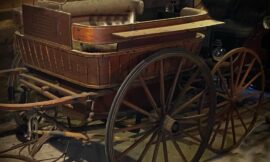
2025 Historic Preservation & Awards CelebrationSunday, June 1 DCHS has a long tradition of spotlighting people and organizations that inspire local history best practices. Here are some of 2025’s awards and recipients: 2025 Historic Preservation Award Recipient It is a great pleasure to honor Mr. Dick Lahey as the recipient of this year’s prestigious Historic Preservation Award. His stewardship of an unparalleled collection of carriages and subject expertise is commendable. He generously opens both his historic home and vast carriage collection, and will personally take us on a tour of both. Learn more about the various awards and honored recipients: Become a sponsor of this year’s Preservation Awards and Celebration event to gain enhanced visibility for your business while supporting the preservation of our community’s rich history. Partner with us today! The sponsorship cost of $500 includes two tickets to the event!
Posted in: For everyone