
Topics
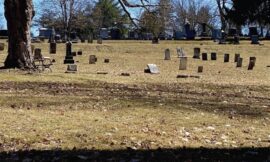
AfAm Burials Rhinebeck
Below: The story of Andrew Frazier, the ancestor. The only Black family with a large plot. Adjacent to and facing, but not technically within, “Colored Section E.” Below: Images and profiles.
Posted in: African Heritage, For everyone, Towns
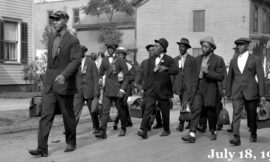
Guide to the Study of Local Black History
Starting Places People Places Things Words from the past Newer Perspectives Other Starting Points The Walter M. Patrice Collection focuses largely on the history of the Smith AME Zion Church in Poughkeepsie, which through Mr. Patrice’s efforts was listed on the national historic register. Although unable to part with the photo album, Mr. Patrice allowed DCHS to take photographs and use the images from his mother’s family’s photo album. In most cases, his mother was not able to identify specific individuals (aside from her father, Jasper Jackson) but she confirmed that it is the family album of Henry and Alma Jackson of the Town of Milan. Below right are some striking images by Reuben Van Vlack of men preparing to serve in World War One in 1918.
Posted in: African Heritage, For everyone
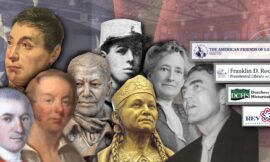
1824: Lafayette in Dutchess County
Big Moves & Intimate Gestures. Why Lafayette’s approach to equality has meant so much to so many. Below is a continually evolving concept that looks at Lafayette through the hearts & minds of those in his 1824 diverse, record-size audiences (and later audiences well into the 20th century) who were at greatly varying degrees of success in realizing the American promise of equality. An in-depth look here: Click full screen icon bottom-left for best view A quick summary below: September 16, 2024 will mark the 200th anniversary of Lafayette’s visit to Dutchess County’s Poughkeepsie and Staatsburg — and Columbia County’s Clermont and Hudson. September 19 will mark the same anniversary for his visit to Red Hook and Fishkill Landing. Part of a 13-month tour of all 24 states, he was the “nation’s guest” at the instigation of President James Monroe, at the invitation of Congress. They sought to rally and unify the country as it approached its 50th anniversary: July 4, 1826. Monroe’s sense that time was running out was prescient. Both John Adams and Thomas Jefferson died on that day. Monroe died July 4, 1831. Lafayette died in 1834 in France. Called a man of two worlds because of his role in the 1776 American Revolution and the French Revolution at the end of the following decade, he was only 19 years old when Congress made him a Major General. In addition to citations for bravery and effectiveness in the military, he contributed his personal wealth, and persuaded the King of France to formally and actively support the American cause. Green indicates public events. Blue indicates private visits. A firm commitment to truth. Big moves & intimate gestures. Toward the end of his life, Lafayette called for a strict adherence to truth. He said that moderation is not the average between two points, but a firm grip of the truth. “When it is said that four and four make eight and an extravagant person pretends that it makes 10, is it more reasonable to maintain that four and four make nine? No, true moderation is discovering what is true, and firmly abiding by it.” Nowhere is this more evident than his views and actions and commitment the idea that all are created equal. To Lafayette, all meant all. In Lafayette we find a very distinct combination of big moves, such gaining the support of France in the American cause, or his own personal support of the same, and small gestures, like kissing the hand of Marie Antionette to calm an angry crowd, or the tip of his hat to an enslaved Kentucky boy (Lewis Hayden shown above) who said that inspired him to become the nationally known abolitionist that he was. American Indians. Big moves: Lafayette assisted the Oneida Nation, America’s ally during the Revolution, with fortifications of their settlement and persuaded them to send 47 of their soldiers to join the Continental Army. They gave him the name Kayewla, or Great Warrior. Small gesturees: Not seeing any Oneida on his June 10, 1825 visit to Utica, a former Oneida stronghold, Lafayette asked his hosts about them, surprising them with the request. When the Oneida came, they had a private audience with Lafayette that he had not granted others. Free and enslaved Blacks: Big moves: Lafayette enlisted James Armistead, an enslaved man in Virginia who had earned a temporary reprieve from his owner, to became an invaluable double-agent spy, infiltrating the highest levels of the British military. Small gestures: but was returned to being enslaved at the end of the war and was denied a pension for lacking a combat role. Lafayette successfully personally petitioned congress on both accounts. White working-class and poor: Big moves: There is less of a direct connection, but an important one nonetheless. For much of his tour, Lafayette travelled with a close friend, Frances “Fanny” Wright. Within a few years, she be so aligned to the Working Men’s Party that the party became known as the Fanny Wright party, and its candidates Fanny Wright men. Small gestures: The Poughkeepsie Telegraph reported that at Forbus house, “We observed among [the crowd] an old revolutionary soldier bearing the marks of poverty and hardship, but whom the general recognized. And it was gratifying to see with what cordiality they shook hands. The old soldier was obliged to yield to the pressure of the crowd and passed off with his eyes sparkling and his countenance lighted up, and was evidently inspired with a new glow of life.” Fanny Wright became close to Lafayette immediately upon meeting him in France in 1821. She travelled with him on a good portion of his 1824/1825 tour including a stay with Jefferson at Monticello. She went on to become associated with the Workingmen’s Party. Lafayette penned a successful letter of support in James Armistead’s request for freedom, which had prior been denied. When Lafayette arrived in Utica in 1825, he insisted the Oneida be invited, who he granted. aprivate audience.
Posted in: 18th Century, For everyone, Veterans

NYS Abolition
“What to the slave is the 4th of July?” At the heart of Frederick Douglass’s 1852 pointed question was the unmistakable irony that the United States was founded on the 1776 premise that all are created equal. When Alexander Hamilton successfully led New York’s US Constitutional Convention in Poughkeepsie in 1788 to endorse joining the union, the three-fifths clause was embedded to accommodate the institution of slavery. This timeline is meant to help us look at some of the local persons and milestones leading up to that date, and eventually leading to the complete abolition of slavery, guarantee of Citizenship, and guarantee of equal treatment under the law through the 13th, 14th, and 15th US Constitutional amendments that were all in effect in 1870. 2027 /1827 July 4th, 2027200th Anniveersary of the end of slavery in New York State. July 4th, 2027 marks the 200th anniversary of the end of slavery in New York State The relief of the end of slavery in New York State in 1827 was greatly tempered by the purely racially motivated 1821 voting restrictions requiring property ownership for Black men only, and the fact that the United States was entering a period of decades of what Abraham Lincoln correctly described as a divided house that could not stand. With a “free north” and a “slave south,” Dutchess County became and important route on the Underground Railroad, with an inland route and a river-oriented route. 2026 JULY 4, 2026The premise and promise that all are created equal began a series of smaller revolutions continue today. 1776 Premise "All Created Equal" The great abolitionist leader, author, and speaker, the former slave Frederick Douglass, famously penned a critique entitled, “What to the slave is your 4th of July?” The 1776 premise that “all are created equal” was followed by the adoption of a US Constitution that literally defined inequality, stating that slave states like New York, could have 3/5ths of the Black population counted toward Congressional representation and the Electoral College for electing the US President. Poughkeepsie, of course, was host to the New York Convention in July of 1788, at the site of the current court house, when New York State, with the smallest margin of any state, agreed to join the United State. 2025 DECEMBER 31, 2025250th Anniversary of the Death of General Montgomery 1775 Death of Montgomery: Whose Freedom? The tragic December 31, 1775 death of Rhinebeck’s General Montgomery in the Revolutionary War is captured in this iconic painting by Trumbull. The event came to symbolize the profound personal sacrifices made by all levels of society during the war, on behalf of freedom. But whose freedom was being secured? In the 1940 Rhinebeck Post Office murals painted by local artist Olin Dows, we see a depiction of an enslaved man making bricks for Montgomery’s estate, Grasmere, which stands today. Also shown here, the Rhinebeck census for 1820 indicating that the widowed Janet Livingston Montgomery, who never remarried, had 12 enslaved men, women and children at her home in Red Hook, Montgomery Place. CLICK FOR DCHS HORIZONS: REV 250 2024 SEPTEMBER 16, 2024200th Anniversary of the Arrival of the Nation's Guest, the Marquis de Lafayette. 1824 Visit of Lafayette: NYS Was a Slave State As the nation’s guest, the American Revolutionary War hero from France, the Marquis de Lafayette, stepped onto the dock at the foot of Main Street, Poughkeepsie in the early morning of September 16, 1824. Newspapers reported it was the largest gathering of men, women, and children — civilian and military — in the village’s history. We know that among the cheering public would have been persons of color, many of whom were enslaved as NY State would not abolish slavery until July 4, 1827. Three years earlier, in 1821, New York instituted a property requirement for a man to be eligible to vote that applied only to men of color. They would have been aware of Lafayette’s outspoken advocacy of the abolition of slavery, his collaboration with a former enslaved man who became a spy and American war hero, and his specific actions freeing the enslaved. The emerging program, DCHS Horizons: the Marquis de Lafayette, will culminate in at event on the 200th anniversary at Revel 32, Cannon Street, Poughkeepsie on the morning of Monday, September 16, 2024. More on that in time. CLICK FOR DCHS HORIZONS: LAFAYETTE 1824 TO 2024
Posted in: African Heritage, For everyone
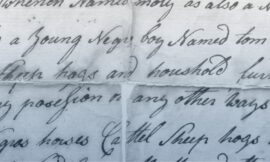
Bill of Sale Four Persons
DCHS Collections: Documents of Enslavement Two adult men, and adult woman, and a young boy are sold in 1775.
Posted in: African Heritage
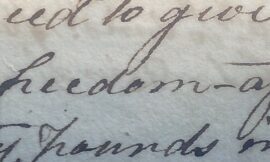
Slavery: Record of Self-Purchase
DCHS Collections: Documents of Enslavement Bartholome Noxon, Jr., records payments by his “negro boy Cezar” who literally purchases his own freedom.
Posted in: African Heritage
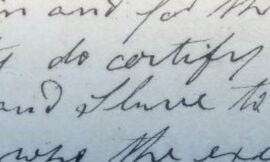
Manumission Approval
DCHS Collections: Documents of Enslavement In this document we see the certification by the overseers of the poor of the Town of Washington (Stephen Thorn and Thomas Howard), permitting Isaac Smith to manumit an enslaved woman named Dinah.They certify that she is under the age of 45, and in such a condition that she will not become an economic burden to the town. This step was required of anyone wishing to manumit an enslaved man, woman, or child. DCHS Collections.
Posted in: African Heritage, For everyone
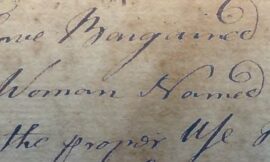
Slavery: Bill of Sale
DCHS Collections Documents of Enslavement A woman named Rachel is “sold” to Christian Tobias on February 4, 1771 Know all men by these presents that I [Mical?/Michael] Obberocker of Beekman Precinct in Dutchess County do for the consideration of the sum of 65 pounds good and lawful money of New York to one in hand paid by Christian Tobias of Charlotte Precinct in said County, have bargained, sold [ ] and delivered one certain Negro woman named Rachel for term of life to have and to hold to the proper use benefit and [ ] of him the said Christian Tobias his heirs executors and assigns… February 4, 1771 Signed in the presence of Bartholomew Noxon, Jr. and Thomas Tobias.
Posted in: 18th Century, African Heritage, For everyone
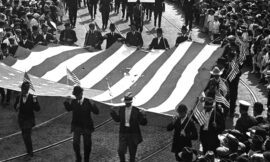
Over Here Traveling Exhibition
Remembering World War One Recognizing the 100th anniversary of the end of World War One, DCHS published two consecutive Yearbooks on the topic, and launched a traveling exhibition that visited every city and town in the county, at least once. You are invited see the exhibition here. The exhibit launched at the FDR Library’s Wallace Welcome Center and then traveled to municipal buildings, libraries, and outdoor events reaching every city and town in the county at least once. Click any image below for best viewing Below, click on any image once, then again, for best viewing.
Posted in: For everyone, Veterans
Expressions
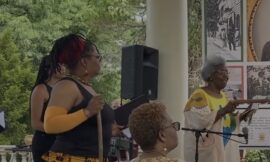
The words of Frederick Douglass as spoken at College Hill on Emancipation Day, 1858, in contemporary expression. Performed under the auspices of Celebrating the African Spirit in recognition of Poughkeepsie’s 2022 Frederick Douglass Day. For best viewing click “Watch on Youtube.” Research & images provided by the Dutchess County Historical Society, Bill Jeffway, Executive Director. Expressions was created, produced and directed by Talent Davis. ©Talent Davis 2022
Posted in: African Heritage, For everyone, Poughkeepsie